Showing posts with label Poetry. Show all posts

Thursday, June 11, 2015

We Are God's Poeima: Poetry and the Human Person

Photo by DeduloPhotos, Morguefile.com
In the midst of novel-writing, volunteering for the Catholic Writers Guild, and starting to prepare for a freshman year of college which seems threateningly close, I find I have neglected my own blog (again) for a full two weeks. Sadly, I still haven't time to make a proper post! In lieu of that, however, I will share a couple of related links I've found over the past few weeks, on that favorite subject of mine--poetry-philosophy-theology.

The first is a video series called For the Life of the World: Letters to the Exiles. The best description I can make of this is that it's a sort of modern, film equivalent of Mere Christianity. While I have not been able to buy the entire series, the trailers look excellent--a straightforward and fervent, contemporary and beautifully artistic exploration of what it really means to be a Christian today. Evan Koons, the creator of the series, also has a Youtube channel with a vlog where he posts numerous other beautiful and insightful bonus videos. They are all worth watching, but today I'd like to draw your attention to the one below. Do not be deceived by the informal and humorous opening--it becomes stunningly profound.

 
The same afternoon after I had watched this video (and was still rather giddy with the beauty and holy thrill of it), I had picked up my latest issue of Dappled Things Magazine and flipped open a random page--the middle of an essay by Ryan Wilson called "How To Think Like a Poet". To my astonishment, my eyes fell upon a paragraph in which the author made reference to the exact same passage from Ephesians that Mr. Koons had in the video above; "we are His poeima."
 
I had encountered the exact same spiritual concept in virtually identical words from two different sources in the span of two hours. Usually when that happens I know the Holy Spirit's up to something. By the time I had read the essay from beginning to end, I felt as if my brain were on fire with enthusiasm and excitement. I have read and thought a good deal about the purpose and craft of poetry (not to mention writing some of my own), but this essay beautifully pulled together the most important concepts into an integrated whole. Read it here on the Dappled Things website. It is not a quick read, but for anyone with any serious interest in poetry, art, and the philosophy (and theology!) behind it, I would strongly urge you to set aside some time to carefully read the entire thing.
 
The work of Mr. Koons and Mr. Wilson is, I think, far more edifying than anything I could write on short notice. Explore, enjoy it, and then go out and be God's poetry!


Thursday, April 16, 2015

45 Years of Thrilling Truth: Rediscovering Apollo 13

 
On this blog about truth, beauty, and literature, most of the adventure stories I write about are fictional. But every once in a while, I encounter those absolutely true adventure stories which are all the more marvelous. The saga of Apollo 13--NASA's "successful failure"--is one of those tales.
 
Tomorrow, April 17, is the 45th anniversary of the splashdown of Apollo 13. Inside that tiny command module which landed safely in the Pacific Ocean were astronauts Jim Lovell, Jack Swigert, and Fred Haise. These three men had just been through a four-day ordeal unlike any other in the annals of survival stories--guiding, with the help of the Mission Control technicians on the ground, a dangerously malfunctioning spacecraft back to earth from 200,000 miles away.
 
For those of you not already familiar with this incredible account of courage, teamwork, and ingenuity, I cannot enough recommend Jim Lovell's own book, Lost Moon: The Perilous Voyage of Apollo 13 (co-authored by Jeffrey Kluger). The popular 1995 movie, directed by Ron Howard and starring Tom Hanks, was based off this book. The movie was actually my first introduction to the story. I watched it over and over as a kid, though I didn't really understand much of it until later. Although naturally a dramatized and somewhat abridged account of the events, the film is thrilling and well done. It's definitely worth a viewing (or a re-viewing, if you've seen it before!). The book is even more exciting. Lost Moon gives the reader a much fuller grasp of the story, including the backgrounds of the main characters, Apollo 13's place in the context of the NASA moon missions, and explanations of the highly-technical spacecraft operations in layman's terms--all woven into a plot so skillful and tight, you'll forget you're reading a non-fiction memoir and think you've plunged into a novel.
 
This past winter, I read the book for the first time, and watched the movie again for the first time in a few years. I was struck very deeply by the romance of the tale--the improbable catastrophe and the even more improbable triumph. And so this high-tech, space-age rescue story came out in my own words as a poem.
 
The references to Ulysses, Ithaca, and other names and places from ancient Homer, are not just my love of the classics randomly making themselves known. The name of Apollo 13's command module was actually Odyssey. (How NASA expected to blast a ship into space named after the most misfortune-ridden quest in literature, and not have a little trouble, is beyond me.)
 
Here, then, is my own retelling of this remarkable tale, in verse. It is dedicated to the three astronauts and Mission Control team of Apollo 13, and all those others who took part in or witnessed the extraordinary events of one April in 1970.


Crucible of Love: Apollo 13, April 17, 1970
By Mary Jessica Woods
 
Reentry
The placid arc of earth fills up the glass
As Odyssey spins silent homeward-bound—
No great Greek fate-tossed warship, lone-captained,
But a thimble of steel crafted for airless seas,
Guided by three chilled crew with rudders of flame.
Four days the ship has fought, a blasted cripple,
Tracing a giddy whorl through death’s void,
Brilliant with cold stars and a starkling sun;
Four days in the gray tiered fort of Mission Control
A thousand have strained at their screens, marking the numbers,
Nursing the Odyssey’s slowing breath and blood;
Four days. Now, minutes from Ithaca,
All guidance is shed, all tillers are abandoned,
Surrendering to the fierce mother-love of Earth.
 
For the mother cries for the children of her body:
The metal drawn from the hard depths of her womb,
The mortals raised in the bounds of her warm breath—
These she clasps close again with a deadly joy,
An engulfing kiss of fire, a crushing strength;
Her fragile sons, knit of soft flesh and bones,
Plunge, trusting, through her crucible of love.
These men who have survived the span of space,
Now merely seek to endure the Earth’s embrace.
 
Splashdown
“Odyssey, Houston standing by, over.
Odyssey, Houston standing by, over.”
The silence on the surface swallows hearts
Of millions: wives, children, parents, friends;
Technicians, flight controllers dragging smokes;
Navy men glassing the South Pacific surge;
And strangers by the hundreds of thousands,
Willing, praying their mortal brothers home.
The sizzle of the empty radio
Is, for three minutes, the smolder of burning hope;
And for the fourth, the crackling choke of fear;
And by the fifth, the sputter of despair—
Again the hopeless greeting ventures out:
“Odyssey, Houston standing by, over.”
 
Of a sudden the radio gives a gasp—
A raspy, rushing hack of stirring life—
And the Odyssey replies to a heart-stopped world.
A roar goes up, a million pulses freed.
Ulysses once hailed his wife and son; now,
The whole world is Telemachus, Penelope,
To three men strapped exhausted in their ship,
Watching the scarlet ‘chutes, with quiet eyes,
Spin like three jewels against the silken skies.


 ~ Poem Ó Mary Jessica Woods, 2015


Photo credit: "Mission Control Celebrates - GPN-2000-001313" by NASA - Great Images in NASA Description. Licensed under Public Domain via Wikimedia Commons - http://commons.wikimedia.org/wiki/File:Mission_Control_Celebrates_-_GPN-2000-001313.jpg#/media/File:Mission_Control_Celebrates_-_GPN-2000-001313.jpg


Thursday, April 9, 2015

Long Live the Weeds! ~ Hopkins' "Inversnaid"

"Loch Heron", September 2014 - Photo by Mary Woods
I happen to live right on the border of where the sprawling Chicago suburbs begin to peter out into flat Illinois farmland. Consequently, in my town, the orderly ranks of streets and lawns and strip malls are occasionally invaded by wildness. Streams flanked by armies of reeds and young willows. Wedges of forest, stubbornly holding out between baseball diamonds and residential build-ups. Spreading creekside trees, like bulwarks of romance against the mundane tyranny of Suburbia.

Loch Heron. Linden Cove. Smuggler's Nook. The Forest of Silver Hands. You won't find these names on any map of Frankfort, IL, but they are important places, nonetheless, for me. They are my own haunts, my own landmarks. Wonder is the guide which leads me to them. They are beautiful spots, in their unobtrusive way, with endless surprises for those who wait and keep open eyes. Old mussel shells, washed from mud, which gleam royal pearl inside. Muskrats nuzzling through cool water, slick-furred and beady-eyed. Geese taking flight in magnificent, thunder-winged, trumpeting hundreds. These are the poems I read and love from God's "First Book" of nature.

Recently I came across a poem--with human words--expressing much the same sentiments. Not very surprisingly, it's by Gerard Manley Hopkins. This 19th-century English poet and Catholic priest is most famous for his inimitable descriptions of nature in pieces like "Pied Beauty", "God's Grandeur", and "Hurrahing in Harvest". Not just descriptions--raptures. The mere way he uses words usually makes me want to fall flat on my face for sheer joy (in the beauty) and utter despair (because I will never even touch his skill and imagination).

Despite that, I never regret picking up a volume of Hopkins. Some of his works are so richly and convolutedly packed with ideas, like glittering mosaics, that they are hard to comprehend. But many of his poems are simpler in concept and no less lovely in art. One of these small gems is "Inversnaid".

Written in 1881, the poem describes the landscape of Inversnaid, a small settlement in the Scottish Highlands near Loch Lomond. Hopkins' natural descriptive abilities, his skill in playing with alliteration and assonance, and a sprinkling of Scots vocabulary, make for a poem as delicious in the mouth as it is lovely in the mind's eye. I myself am not certain what all the words mean precisely, but I let my ear create images for me--if that makes the least ounce of sense.

Finally, Hopkins ends the poem with a poignant cry for the preservation of wilderness. Let it be left, he says, O let it be left. It is good for the mind and body; it is good for the soul. Let it be left--even small corners of it, for the good of us all.

Inversnaid
By Gerard Manley Hopkins
 
This dárksome búrn, hórseback brówn,
His rollrock highroad roaring down,
In coop and in comb the fleece of his foam
Flutes and low to the lake falls home.
 
A wíndpuff-bónnet of fáwn-fróth
 
Turns and twindles over the broth
 
Of a póol so pítchblack, féll-frówning,
 
It rounds and rounds Despair to drowning.
 
Degged with dew, dappled with dew
 
Are the groins of the braes that the brook treads through,
 
Wiry heathpacks, flitches of fern,
 
And the beadbonny ash that sits over the burn.
 
What would the world be, once bereft
 
Of wet and of wildness? Let them be left,
 
O let them be left, wildness and wet,
 
Long live the weeds and the wilderness yet.


Thursday, April 2, 2015

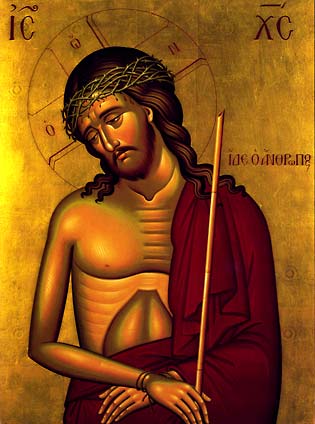
Bridegroom Song: A Poem for Great and Holy Week


The title of the of icon above is "Christ the Bridegroom". This juxtaposition of concepts, this inherent mystery, strikes me to the heart every Great Fast. This is how Christ comes to His divine wedding with His bride, His people, His Church--God bleeding, tortured, utterly humiliated. Earlier this Lent, my own meditation on this icon called forth this poem into being. May we all be blessed as we enter into His Passion tonight and tomorrow.

A note: The accents indicate an unusually long stress on a word, and should be read as such. The form is meant to be extremely simple and forceful, expressing, I hope, something of undiluted longing and anguish.


Bridegroom Song

By Mary Jessica Woods
  
Sée hów I come to thee—
Wrísts ráw and bound for thee,
Brów blóody-crowned for thee,
Wílt thóu come to me?

Lóok hów I gaze for thee—
Éyes sált-blind for thee,
Weeping God divine for thee,
Wílt thóu come to me?

Féel hów I ache for thee—
Shoulders stiff with blood for thee,
Féet fóuled in mud for thee,
Wílt thóu come to me?

Hear my lóve sóng to thee—
Whíp-wáils high for thee,
Every shaking cry for thee,
Wílt thóu come to me?

Knów, nów, my thirst for thee—
Bríde, my own, I long for thee,
Behold my sorrow strong for thee,
Wílt thóu come to me?

 
~ © Mary Jessica Woods, 2015 

Thursday, March 12, 2015

A Mishmash of Masters: My Commonplace Book


Six AM on a weekday morning found me at the breakfast table, bleary from another late night, novel-writing like a madwoman. As I munched my toast and swallowed tea, desperately hoping for an energy burst, I opened up Homer's Odyssey--meals are often my only time for reading-- and stared at the first lines of Book II:

Now when the child of morning, rosy-fingered Dawn, appeared, Telemachus rose and dressed himself. He bound his sandals on his comely feet, girded his sword about his shoulder, and left his room looking like an immortal god.

I almost burst out laughing. Man! Why can't I get up like that in the morning?

The lines, besides making me smile, also struck my poetic imagination. I wanted to remember them. In fact, they delighted me so much that they urged me to restart my commonplace book.

I have kept a commonplace book since May of 2013. I was inspired to begin by a passage in the "Guide to Daily Reading", an introduction to a set of books The Pocket University, published in 1934. Among a series of lovely little essays on books and the art of reading in general, I came across this passage by Richard LeGallienne, in a section on how to remember what one reads:

Yet it often happens that he [the reader] forgets much that he needs to remember, and thus the question of methodical aids to memory arises.

One's first thought, of course, is of the commonplace book. Well, have you ever kept one, or, to be more accurate, tried to keep one? Personally, I believe in the commonplace book so long as we don't expect too much from it. Its two dangers are (1) that one is apt to make far too many and too minute entries, and (2) that one is apt to leave all the remembering to the commonplace book, with a consequent relaxation of one's own attention. On the other hand, the mere discipline of a commonplace book is a good thing, and if--as I think is the best way--we copy out the passages at full length, they are thus the more securely fixed in the memory. A commonplace book kept with moderation is really useful, and may be delightful.

I have certainly found my commonplace book a delight, and in fact a very helpful tool for memory. I don't always copy long passages, but I may enter a short poem, or a few paragraphs of prose, or verses from spiritual reading and Scripture. The book has proven a good way for me to memorize the latter. In some places it has served double duty as a prayer journal, when I copy down Bible verses and reflection to help me through some spiritual trial. The other entries--the poems, the bits of novels, the Gaelic song lyrics, and other miscellania--are my personal treasure trove of fond memories and future inspiration.

My main criterion when choosing passages for a commonplace book entry is the strikingness of them. Occasionally I will enter things that I think I simply ought to memorize--like the Creed, or, more recently, the list of American presidents--but usually I only copy a passage because it plucked some chord in my heart, of drama, or beauty, or romance. Thus, flipping through my commonplace book is a detailed portrait of the characters, scenes, themes and words which have most shaped my thoughts and writing over the past two years.

Many of these entries I have already shared on my blog--like Frost's "My November Guest" and "The Lone Striker", Stevenson's novels and poems, Eliot's Murder in the Cathedral, Tolstoy's War and Peace, and others. But many I have not shared. Here, then, is a selection of my favorite passages from my commonplace book. May they inspire you to read some of the beautiful works they come from!

May 22, 2013

"On this level, Ahab's hammock swings within; his head this way. A touch, and Starbuck may survive to hug his wife and child again. -- Oh Mary! Mary! -- boy! boy! boy! -- But if I wake thee not to death, old man, who can tell to what unsounded deeps Starbuck's body this day week may sink with all the crew! Great God, where are Thou? Shall I? Shall I? -- The wind has gone down and shifted sir; the fore and main topsails are reefed and set; she heads her course."

"Stern all! Oh Moby Dick, I clutch thy heart at last!"

Such were the sounds that now came hurtling from out the old man's tormented sleep, as if Starbuck's voice had caused the long dumb dream to speak.

The yet levelled musket shook like a drunkard's arm against the panel; Starbuck seemed wrestling with an angel; but turning from the door, he placed the death-tube in its rack, and left the place.

"He's too sound asleep, Mr Stubb; go thou down, and wake him and tell him. I must see to the deck here. Thou know'st what to say."

~ Herman Melville, Moby Dick, Chapter 123

 
I DARE someone to tell me Moby Dick is a big boring book about a whale.
 
June 10, 2013
 
The Gobhaun Saor and his son were left in the dun without light, without food, and without companions. Outside they could hear the heavy-footed Fomorians, and the night seemed long to them. "My sorrow," said the son, "that I ever brought you here to seek a fortune! But put a good thought on me now, father, for we have come to the end of it all." "I needn't blame your wit," said the father, "that had as little myself. [...]"
 
"If we had light itself," said the son, "it wouldn't be so hard, or if I had a little pipe to play a tune on." He thought of the little reed pipe he was making the day the three Fomorians came to him, and he began to search in the folds of his belt for it. His hand came on the lock of wool he got from Mananaun, and he drew it out, "Oh, the fool that I was," he said, "not to think of this sooner!" "What have you there?" said the Gobhaun. "I have a lock of wool from the Sea God, and it will help me now when I need help." He drew it through his fingers and said: "Give me light!" and all the dun was full of light. He divided the wool into two parts and said: "Be cloaks of darkness and invisibility!" and he had two cloaks in his hand colored like the sea where the shadow is deepest.
 
"Put one about you," he said to the Gobhaun, and he drew the other round himself. They went to the door; it flew open before them; a sleep of enchantment came on the guards and they went out free. "Now," said the son of the Gobhaun Saor, "let a small light go before us"; and a small light went before them on the road, for there were no stars in Balor's sky. When they came to the Dark Strand the son struck the waters with his cloak and a boat came to him. It had neither oars nor sails; it was pure crystal, and it was shining like the big white star that is in the sky before sunrise. "It is the Ocean-Sweeper," said the Gobhaun. "Mananaun has sent us his own boat!" "My thousand welcomes before it," said the Son, "and good fortune and honor to Mananaun while there is one wave to run after another in the sea!"
 
They stepped into the boat, and no sooner had they stepped into it than they were at the White Strand, for the Ocean-Sweeper goes as fast as a thought and takes the people she carries at once to the place they have their hearts on. "It is a good sight our own land is!" said the Gobhaun when his feet touched Ireland. "It is," said the son, "and may we live long to see it!"
 
~ From "How the Son of the Gobhaun Saor Shortened the Road", retold by Ella Young
 
This is Irish fairy-tale at its most striking and moving. Elements of this story haunt my own Celtic tale.
 
August 8, 2013
 
Hotspur: He shall be welcome too. Where is his son,
The nimble-footed madcap Prince of Wales,
And his comrades, that daff'd the world aside,
And bid it pass?
Vernon: All furnished, all in arms;
All plumed like estridges that with the wind
Baited like eagles having lately bathed;
Glittering in golden coats, like images;
As full of spirit as the month of May,
And gorgeous as the sun at midsummer;
Wanton as youthful goats, wild as young bulls.
I saw young Harry, with his beaver on,
His cuisses on his thighs, gallantly arm'd,
Rise from the ground like feather'd Mercury,
And vaulted with such ease into his seat,
As if an angel dropp'd down from the clouds,
To turn and wind a fiery Pegasus
And witch the world with noble horsemanship.
Hotspur: No more, no more: worse than the sun in March,
This praise doth nourish agues. Let them come;
They come like sacrifices in their trim,
And to the fire-eyed maid of smoky war
All hot and bleeding will we offer them:
The mailed Mars shall on his altar sit
Up to the ears in blood. I am on fire
To hear this rich reprisal is so nigh
And yet not ours. Come, let me taste my horse,
Who is to bear me like a thunderbolt
Against the bosom of the Prince of Wales:
Harry to Harry shall, hot horse to horse,
Meet and ne'er part till one drop down a corse.
 
William Shakespeare, Henry IV Part I, Act 4, Scene 1


Could you possibly heap any more praise on an enemy than Vernon does on young Prince Harry (the future King Henry V of Agincourt fame)? And can't you just see Hotspur fuming in envy as he leaps astride his charger? This Shakespeare play is as gripping as an adventure novel!

~
 
Epilogue: If you have actually read to the end of this post, I thank you from the bottom of my heart. There's a heck of a lot more I'm dying to share from my commonplace book, and this post makes me realize I should do it more often. Until next time--happy reading.

Thursday, March 5, 2015

The King of Glory Enters: A Journey through the Liturgy of the Presanctified Gifts


It is a Friday evening during Great Lent. The church is muted, except for the rhythmic rush and jingle of the bells of the incenser as the deacon moves about the sanctuary. The cantor and people raise their voices in an opening hymn--a traditional Slavic Ruthenian chant, perhaps the heartbreaking "Now Do I Go to the Cross":
Now do I go to the Cross,
nowhere else shall I find You,
Jesus Lord, peace of my soul.
 
There I shall find the Mother of God,
sorrow and pain piercing her heart.
Sorrow now is all I feel.
 
The deacon strides out through the side of the icon screen, stands before the royal doors, and declares to the celebrant in the sanctuary, "Father, give the blessing!"
 
The Liturgy of the Presanctified Gifts has begun.
 
The Liturgy of the Presanctified Gifts--often referred to as "Presanctified Liturgy"--is a unique Lenten tradition among the Eastern Catholic and Orthodox churches. In form, it is essentially a Vespers service with the distribution of the Eucharist. Besides that, one important fact distinguishes it from a regular Divine Liturgy--it has no consecration. The reason, as the name of the service implies, is that the gifts of bread and wine are pre-sanctified--they have already been consecrated on the previous Sunday.
 
Roman Catholics should be familiar with this concept through their commemoration of Good Friday. Good Friday, in the Western Church, is an "a-liturgical" day--meaning it is not allowed to consecrate the Eucharist that day. But in the Eastern tradition, every weekday of Lent is considered a-liturgical. Thus, during the Great Fast, we celebrate Presanctified Liturgy with the already-consecrated Body and Blood every week--typically on Wednesdays and Fridays.
 
The service begins, as the normal Vespers service always does, with the chanting of Psalms. The words are utterly familiar, but the mournful Lenten melody lends them a special poignancy. Sorrow, joy, peace and longing strain forth in the flow of alternating verses. The Psalms finish with the singing of the Stichera, or propers for the day--liturgical poems often centering on a theme of Lenten struggle or repentance.
 
The service proceeds with the Hymn of the Evening, "O Joyful Light"--also a standard part of Vespers and one of the most ancient Christian texts. Traditionally, the church is dark or only partially lit up until this point; now, as we sing of the Light of Christ, the church is fully lit:
 
O Joyful Light of the holy glory of the Father Immortal,
the heavenly, holy blessed One, O Jesus Christ:
Now that we have seen the setting of the sun, and see the evening light,
we sing to God, Father, Son, and Holy Spirit.
It is fitting at all times to raise a song of praise in measured melody to you,
O Son of God, the Giver of Life.
Therefore, the universe sings your glory.
 
Next come the Prokeimena--the equivalent of Responsorial Psalms--and the readings. Unless the service takes place during Holy Week or some other major feast day, the readings are always from the Old Testament--Genesis and Proverbs, Exodus and Job. These books encompass essential Lenten themes: returning to beginnings to discover who we are and ought to be; humility and desire to pursue wisdom; escape from sin; and the purpose of suffering and repentance.
 
After the readings, we chant the Solemn Evening Psalm: Let my prayer arise to you like incense, and the lifting up of my hands like an evening sacrifice. The people sing this refrain standing, then kneel as the priest chants each of his verses. The bodily gestures of repentance continue with the full prostrations performed during the reciting of the Prayer of St. Ephrem (see this post for the text of the prayer).
 
During a regular Divine Liturgy, the text sung after the readings is the Cherubic Hymn. As the clergy process around the church with the yet-unconsecrated gifts, we sing of the angels and of the mystical sacrifice in which we are about to participate. But in a Presanctified Liturgy, the bread and wine the clergy hold are already the Divine Body and Blood of Christ. Thus the text is slightly different. This, as the priest and deacon prepare in the sanctuary, is what we sing:
 
Now the powers of heaven are serving with us invisibly.
For behold the King of Glory enters.
They escort the mystical sacrifice, already accomplished.
 
When the clergy process out from the sanctuary--the priest holding up God and the deacon incensing Him--the church hushes. The people bend to the ground in a full prostration. In complete silence--the only noise being the slow tread of the clergy, and the jangle of the incenser--we adore Christ passing through our midst.
 
(To understand the full power of this moment, you have to understand the ethos of Eastern liturgies in general. Unlike in the Western Mass, there are few moments of silence and meditation during services. Literally everything besides the homily is sung, and the litanies, responses, and hymns follow one upon the other with hardly a pause. This fosters an atmosphere of holy exuberance and joy--a gorgeous and occasionally overwhelming experience, especially for newcomers! In contrast, quiet moments during liturgy, even accidental ones, are rare. Thus a period of prolonged, purposeful, and solemn silence--as during the Great Entrance of Presanctified Liturgy--is almost overwhelming. To close the eyes and touch the head to the cold floor and listen, in that breathless hush, to God walking by--I am no theologian, but in my own small experience, it is a pinnacle of love and existence.)
 
After the Great Entrance, the service moves fairly quickly towards Communion. The text of the Communion Hymn is the beautiful Psalm verse, "Taste and see that the Lord is good." And we do indeed taste and see. In the East, the Eucharist is received not in the separate forms of wine and an unleavened host, but combined--small pieces of leavened bread soaked in wine, dropped into the mouth by a spoon. On regular Sundays, the loaves of bread used are fresh, and soft wine-soaked pieces dissolve easily in the mouth. But for Presanctified Liturgy, the Body of Christ--being, after all, in the physical form of bread which has been sitting in the tabernacle since the previous Sunday--is, well, harder than usual. Hard enough to require chewing. There is nothing irreverent about this. Christ is our Nourishment, body and soul; why should He not come to us solid and physically filling, as well as spiritually saving?
 
After Communion the service concludes in a tone of solemn thankfulness and joy. In the Byzantine Ruthenian tradition, the short final hymn "Having Suffered" is sung three times, in English and Old Slavonic. Sometimes, during its passionate mournful phrases, the church is darkened again, leaving, once more, only the candles burning before the icon screen, in mystical darkness.
 
 
(For the extra-curious or musically inclined reader, below are some to videos I've hunted up, providing a sample of the music I've referenced in this blog post. For the full experience, of course, visit your nearest Eastern Catholic--or Orthodox!--church.)
 
Now Do I Go to the Cross ~ A slightly different version, melodically, from the hymn I'm familiar with, but with the same text and surging mournful spirit. Beautiful.
 
Let My Prayer Arise ~ A short clip from a liturgy celebrated in one of our own Byzantine Catholic Ruthenian parishes in the Midwest by our Bishop John Kudrick. The video shows the clergy in the sanctuary; you can see the congregation through the open royal doors in the icon screen. The video includes the recitation of the Prayer of St. Ephrem directly afterwards.
 
Let My Prayer Arise ~ A choral arrangement of the Solemn Evening Psalm by Russian composer Dmitry Bortniansky. A favorite of mine, and hauntingly performed in this recording.


Thursday, February 26, 2015

The Celtic Stereotype: A Rant


It's the end of February and Chicago is still buried in snow. But recently I've seen a certain kind of green plant popping up in various places--usually on windows or walls of homes and storefronts, or plastered on posters and event announcements. It's the clover, and it's been making its annual appearance as the United States (prematurely, as usual) prepares to celebrate its absurd version of St. Patrick's Day.

I know St. Patrick's Day is still weeks away. And I know I should be used to how our secular culture trashes real holidays. But the diluting of this particular holiday touches one of my pet peeves--the romanticization of the Celtic.

I've always had a vague interest in Celtic culture, given my heritage. My grandmother's maiden name was Gallagher, and there is a family legend (mostly a joke, but who knows?) that our ancestors were Irish horse thieves. However, my family never put special emphasis on our Celtic background, so it wasn't until I read Robert Louis Stevenson's Kidnapped that I began unearthing the Celtic riches for myself.

Kidnapped, of course, is set in Scotland, so the book left me obsessed with all things Scottish. Having quickly depleted the list of Scottish stories by Stevenson, I turned next to Walter Scott. In books like Waverly and Rob Roy I discovered more adventure, more romance, more delicious Scots dialect. Soon after I found myself writing a short story (very much inspired by Rob Roy) which featured an 18th century Highland village. Now, in Scott's story, the stereotypical Highland peasant, along with being ragged and uneducated, spoke an unintelligible language called Gaelic. So for fun, I thought I'd translate bits of my story's dialogue into Gaelic. It would give it that more foreign, romantic atmosphere, wouldn't it?

An internet search revealed no automatic translations tools for Scottish Gaelic. But it did turn up a truckload of resources for learning Scottish Gaelic. Curious, I tried out a few websites. (The first thing that boggled me--not surprisingly--was the phonetics. "You mean, mh sounds like v? And th sounds like h?? And what's with dh--it sounds like g???")

Despite my bewilderment, I was hooked. My study of modern Scottish Gaelic launched me into a whole new consideration of Celtic culture. It was more than romance. It was real. Its language was more than unintelligible babble--it was a poetic, expressive tongue, both liquid and edgy. Its people were more than the nostalgically uncivilized peasants portrayed by Scott--they were human beings, who lived, worked, prayed, loved, sang, mourned, rejoiced. Their lives were harsh and often primitive by our standards, but that did not reduce their humanity.

After discovering this nugget of true Celtic culture through the Gaelic, I found I could not return to my old obsession with romantic Scotland. Scott's portrayal of the primitive Highland life irritated me. On the other hand, movies like Brigadoon, with its over-idyllic Highland village (not to mention its Highland villagers who speak in Lowland Scots), annoyed me as well. The truth lay deeper than the bagpipes and plaids, the thatched roofs and hairy cattle. I don't mean to say that these things were not a real part of Highland culture. They were--but not in the picture-postcard way they're often presented.
Brigadoon, the musical
Perhaps I split hairs. But I insist the deeper study of a culture reveals beauties far more engaging than any romantic stereotype, because it reveals real human personalities. To prove it, I here share the English translation of an old Gaelic song, once sung by real Highland women while milking real Highland cows.

Come, Mary, and milk my cow,
Come, Bride, and encompass her,
Come Columba the benign,
And twine thine arms around my cow.
Ho my heifer, ho my gentle heifer,
My heifer dear, generous and kind,
For the sake of the High King take to thy calf.
 
Come, Mary Virgin, to my cow,
Come, great Bride, the beauteous,
Come, thou milkmaid of Jesus Christ,
And place thine arms beneath my cow.
Ho my heifer, my gentle heifer.
 
Lovely black cow, pride of the shieling,
First cow of the byre, choice mother of calves,
Wisps of straw round the cows of the townland,
A shackle of silk on my heifer beloved.
Ho my heifer, ho my gentle heifer.
 
My black cow, my black cow,
A like sorrow afflicts me and thee,
Thou grieving for thy lovely calf,
I for my beloved son under the sea,
My beloved only sun under the sea.
 
(From "Carmina Gadelica" Vol. 1, collected and translated by Alexander Carmichael)
 
This song is chock full of reality. It reflects the deep Christianity of the old Highland peasantry. It reveals their poetic love of nature and animals. And it hints, in that mournful last stanza, of the harsh and tragic side of their lives. No Broadway writer could have reproduced the glinting nuance of joy and sorrow in such a song. Only a real woman, who had prayed and milked cows and lost a son to the sea, ever could have composed it.


In this country St. Patrick's Day is primarily an excuse for a party, featuring small three-leafed plants, small green-clothed men, and green beer. But I challenge my readers this year to treat it as a chance to explore real Celtic culture. Read the prayer of St. Patrick. Listen to a traditional Gaelic song. Never mind the cute cartoon leprechauns--read one of the ancient Irish myth cycles, like The Cattle-Raid of Cooley (a warning, though: Cu Chulainn and company are not for the faint of heart!).

Enjoy a bit of this true heritage. I bet you won't be able to go back to the stereotypes, either.

Thursday, February 19, 2015

The Arena of Virtues: Selections from Cheesefare Sunday

The Ladder of Divine Ascent
Yesterday, for Roman Catholics around the world, marked the official beginning of Lent. Ash Wednesday is a beautiful and solemn tradition in the West. But the Eastern lung of the Church offers its own unique set of services meditating on the beginning of (as we call it) the Great Fast. For us, the Fast began four days ago, on the evening of Cheesefare Sunday.

The name requires a bit of explanation. The Church, in her wisdom, realizes that the Fast has a tendency to sneak up on us all. So she lets us ease into the penitential season in stages--a sort of pre-preparation period. The Sunday Gospel readings for the weeks leading up to the beginning of the Fast features characters like Zaccheus and the Prodigal Son, who are called to repentance and reconciliation. The second-to-last Sunday before Lent is called Meatfare Sunday--for the very simple reason that it's the day we "say farewell" to eating meats until after Pascha. Similarly, the Sunday after that is labeled Cheesefare Sunday--the final day we can indulge in dairy products.

However, the focus of the liturgical prayers on Cheesefare Sunday is anything but food. Instead, the prayers for Vespers and Matins commemorate the Expulsion of Adam and Eve from Paradise. Through the plethora of hymns we enter into the character of Adam, weeping "over the memory of what used to be". The these verses from Ode 4 the Matins Canon bemoan the sorrow of separation from the Creator:

I was filled with honors when I was with you in Eden, O Master. Woe is me! How was I deceived by the envy of the Devil and rejected far from your face?
 
Choirs of angels, pour out your tears for me, and also you beauties of Paradise, the magnificent trees; for I was led astray by my misfortune and chased far away from God.
 
O pleasant meadows, O sweetness of Paradise, you trees planted by God, let your leaves, as so many eyes, pour out tears for my nakedness and my estrangement from the glory of God.
 
The poetry brims with the tone of a funeral dirge, and forces us to confront our own state of sin. But the Church hardly leaves us to drown in despair. By the second half of Matins, the verses during the Psalms of Praise offer a stern but joyful encouragement for the spiritual struggle to come:
 
The arena of virtues is now open!
Let all who wish to begin training now enter!
Prepare yourselves for the struggle of the Fast;
Those who strive valiantly shall receive the crown!
Let us put on the armor of the Cross to combat the Enemy,
Taking faith as our unshakable rampart.
Let us put on prayer as our breastplate,
And charity as our helmet.
As our sword, let us use fasting, for it cuts out all evil from our hearts.
Those who do this shall truly receive the crown
From the hands of Christ, the almighty One, on the day of judgement.
 
(Because I am an incurable romantic, that particular verse has always held a special place in my heart. Being patient and charitable and not taking that extra helping of breakfast cereal become more endurable when viewed in terms of an epic quest.)
 
The most distinctive service of Cheesefare Sunday--Forgiveness Vespers--takes place after the Divine Liturgy. (Although it's technically an evening service, many parishes, for the sake of convenience, celebrate it directly after the morning Liturgy.) Forgiveness Vespers marks the official beginning of the Fast. During the service, the altar cloths and clergy vestments are changed from gold to the penitential red. The ordinary melodies for the psalms and litanies switch over to the plaintive Lenten tones. Finally, we recite the signature prayer of the Great Fast--the Prayer of St. Ephrem--complete with full-length prostrations after each stanza:
 
The Prayer of St. Ephrem
 
Lord and Master of my life,
spare me from the spirit of indifference, despair,
lust for power, and idle chatter. (Prostration)
 
Instead, bestow on me, your servant,
the spirit of integrity, humility,
patience, and love. (Prostration)
 
Yes, O Lord and King,
let me see my own sins
and not judge my brothers and sisters;
for you are blessed forever and ever. Amen. (Prostration)
 
The beautiful words combined with the physical action of humility make for an unforgettable experience of the solemnity of the season.
 
Finally, the service concludes with the profound Ceremony of Mutual Forgiveness. In it, the celebrant and the congregation ask each other for forgiveness, and then each person comes forward to embrace and ask forgiveness of every other individual. It's a moving tradition, which forces us to step out of our personal shells and commit to the Fast as a community. All the while, the cantor quietly intones the Canon for Resurrection Matins--giving us a tiny glimpse of our Lenten goal:
 
Let us cleanse our senses
that we may see the risen Christ
in the glory of his resurrection
and clearly hear him greeting us:
"Rejoice!" as we sing the hymn of victory.
Christ is risen from the dead!
 
(But, shhh! Not quite yet!)
 
Indeed, let us cleanse our senses, body, mind, and soul. A blessed Great Fast to you all!


Thursday, January 15, 2015

Faith in the Night Sky: Frost's "Choose Something Like a Star"


Winter nights are best for stargazing. The dark comes on early, and the air--if bitter--is beautifully clear. Often, if I happen to be outside for a moment on a cloudless winter evening, I stop to greet a few old friends--the sweeping Big Dipper, the jagged Cassiopeia, the faint but distinctive Pleiades, and marching over all, the majestic Orion. They're not much compared to the grandeur of the Milky Way, but considering that I live in a Chicago suburb, I just take what I can get.

On that note I'd like to pull out a Robert Frost poem concerning stars. "Choose Something Like a Star" is one of the final pieces in Frost's Complete Poems 1949. It's one of his more metaphorically profound poems (and Frost is really, really good at being metaphorically profound), and, I think, a particularly pointed reminder to us as Christians and American citizens. Read away.

Choose Something Like a Star
By Robert Frost
 
O Star (the fairest one in sight),
We grant your loftiness the right
To some obscurity of cloud--
It will not do to say of night,
Since dark is what brings out your light.
Some mystery becomes the proud.
But to be wholly taciturn
In your reserve is not allowed.
Say something to us we can learn
By heart and when alone repeat.
Say something! And it says, 'I burn.'
But say with what degree of heat.
Talk Fahrenheit, talk Centigrade.
Use language we can comprehend.
Tell us what elements you blend.
It gives us strangely little aid,
But does tell something in the end.
And steadfast as Keats' Eremite,
Not even stooping from its sphere,
It asks a little of us here.
It asks of us a certain height,
So when at times the mob is swayed
To carry praise or blame too far,
We may choose something like a star
To stay our minds on and be staid.
 
Let me say it outright. I think the entire poem is one long metaphorical reflection on faith in God. However, the metaphor is gorgeously layered. Take a look at the first three lines from this angle:
 
O Star (the fairest one in sight),
We grant your loftiness the right
To some obscurity of cloud--
 
To me this comes across quite clearly as an appeal to a Divine Being. I.e., "Dear God, you are so infinitely greater than our human minds, that we admit we can't understand you fully. So go ahead--be a little mysterious." Of course, "we" don't stop there. We'd like a word or two of guidance:
 
But to be wholly taciturn
In your reserve is not allowed.
Say something to us we can learn
By heart and when alone repeat.
Say something! And it says, 'I burn.'
 

The cryptic poignancy of that response echoes the scene of Moses and the burning bush. Indeed, since it is a star that is speaking, "I burn" seems a similar statement of essence to the Lord's "I AM"--in poetic terms, of course. But "I burn" also carries the meaning, "I desire." Desire what? It's no wonder we're a little confused:
 
...And it says, 'I burn.'
But say with what degree of heat.
Talk Fahrenheit, talk Centigrade.
Use language we can comprehend.
Tell us what elements you blend.
 
Here, on the surface, Frost contrasts the poet's understanding of the star with the scientist's. The scientist wants something to measure; Frost makes it clear this star's meaning is immeasurable. The line of thought is the same if the star represents God. God's existence cannot be explained (or unexplained) by time- and matter-bound measurements. Not that He is irrational--rather, He is rational and more. The next lines give us a hint of this.
 
Not even stooping from its sphere,
It asks a little of us here.
It asks of us a certain height...
 
A certain height--the height, hope, and dignity of faith. A height that lets us think and act above the bewildering vicissitudes of changing times and social mores:
 
So when at times the mob is swayed
To carry praise or blame too far,
We may choose something like a star
To stay our minds on and be staid.
 
(The pun in the final line is brilliant, by the way.) This is the bit I thought particularly relevant to us as Americans. Although we may technically live in a republic, when it comes to general culture we are definitely a democracy--as in, mob rule. The pressure to be politically correct, "to carry praise or blame too far," can be almost overwhelming. That's why "we may choose something like a star".
 
But even that isn't quite the right way to put it, considering what we've seen from the rest of the poem. Remember? "It asks a little of us here. / It asks of us a certain height". The title of Frost's poem may be "Choose Something Like a Star", but that is a line of ultimate understatement and irony. In reality, the Star chooses us.


Wednesday, December 24, 2014

Nollaig Chridheil! ~ Two Gaelic Christmas Carols


Nollaig Chridheil dhuibh, a h-uile duine. Merry Christmas, everyone.

Today I'm afraid you, my readers, will have to endure another outburst of my Scottish geekiness. Fortunately, this one is appropriate to the season, and it involves more listening than reading. So turn up your speakers and prepare yourself for a wash of musical Christmas beauty.

~
 
Last Christmas I taught myself one Gaelic carol. That was all I had time for, what with the host of other preparations I had to make for the feast day. But this year I was eager to discover more: traditional Gaelic music holds a special place in my heart and I was sure there were some gorgeous Christmas songs out there just waiting for me. I was not disappointed. In my search I quickly uncovered the album Duan Nollaig: A Gaelic Christmas, by Fiona Mackenzie.
 
The album is lovely as a whole, including, along with the traditional Scottish carols, translations of some English favorites, like "In The Bleak Midwinter" and "Silent Night". Two of the native Gaelic songs in particular caught my attention: "Oran na Nollaig" (The Christmas Song) and "Bha Buachaillean an Dùthaich Shear" (There Were Shepherds in an Eastern Country). Below I post the videos and English translations of each song.
 
 
As soon as I read the lyrics to this song I knew I had to learn it. The words tell the story of a different kind of "Night Before Christmas"--this time, the midnight visitor is not a jolly St. Nicholas, but the voice of the Holy Spirit Himself. I invite you to read along as you play the video.
 
Oran na Nollaig (The Christmas Song)
 
The night before Christmas sleep fled far from me,
I lay on my elbow with a whisper in my ear
Saying, "Arise, get dressed and we'll go for a wander--
To a town far away across the ocean.
 
"There'll be a star in the sky," said the voice in my ear:
"Follow it and you'll get your reward:
You will glimpse the child they call the Lamb
Lying in a manger--his cheek like a star.
 
The Lamb of Reconciliation in the manger. Give him hospitality and welcome.
The Savior of the world, the beautiful child of joy,
What the prophets reported in the Bible
You will see tomorrow night--come sail with me."
 
"Who are you," I asked, "Whose voice do I hear?
Who leads me to the sleeping child?
Why did you invite a poor, wretched sinner?
Come and tell me the reason--don't leave me so quickly."
 
"Farewell," said the whisper, "I'm the Author of the book;
May the song of Christmas be daily on your lips
May the child's mercy follow your steps--
As long as you're on earth give honor to Him."
 
If you've read this far, it means you've survived the beauty of Fiona Mackenzie's voice and the heart-wrenching violin interludes. I congratulate you! But you ain't seen nothing yet...
 
When I first heard the opening harp chords of "Bha Buachaillean an Dùthaich Shear", a chill pricked my spine and felt my heart pulled into a kind of swoon. This I had to learn! To my surprise, when I looked up the lyrics, they were merely a straightforward account of the angels' appearance to the shepherds on Christmas Eve. The story itself was utterly familiar, but the Gaelic poetry and swoon-inducing melody infused it with a new beauty, gentleness, and wonder. The song sounds like stars. I'm sorry, that's the only way I can describe it.


Bha Buachaillean an Dùthaich Shear (There Were Shepherds In An Eastern Country)
 
There were shepherds in an eastern country,
Watching their flocks by night,
When there came an angel from heaven,
And the slope lit up with light.
The men were terrified but he said to them,
"Fear not, for I bring good tidings of great joy
To you and all generations."
 
"The Savior of the world,
The Christ, the Holy Lord,
Tonight has come to Bethlehem,
A helpless, gentle child;
And you shall find him securely wrapped
In a warm manger in the hay,
The precious, heavenly babe
Promised to us since the beginning of time.
 
Thus said the angel to them,
And suddenly the heavens were full
Of angels singing sweetly
And this was what they sang:
Glory to God in the heavens,
Everlasting peace of earth!
Glory to God in the heavens,
Everlasting peace of earth!"
 

I have no doubt these two carols will become part of my favorite Christmas repertoire. There is something breathtaking about viewing Christ's birth through the eyes of another culture's language. I have enjoyed it immensely, and I hope I've helped open your ears to another world of Christmas music. Beannachd leibh, agus Nollaig Chridheil! (Blessings and a Merry Christmas to you all!)