Saturday, April 19, 2014

Sorrowful Wonder and Joyful Impatience: Jerusalem Matins


One of my favorite services of the Church year in the Byzantine tradition is Holy Saturday morning, Jerusalem Matins. It's two hours long and is full of haunting melodies and beautiful texts that are never sung any other time. The highlight of the service is the three Stations, a series of short hymns sung in between verses of Psalm 118. The first theme, in these lines from the First Station, is the sheer strangeness of God in a grave:

In a grave they laid you, O my Life and my Christ,
yet the Lord of Death has been destroyed by your death,
and from you, the world now drinks rich streams of life.

Lo! how fair his beauty! Never was man so fair!
but how strangely death has changed that face that we knew
though all nature owes her beauty to him.

O my sweet Lord Jesus, my Salvation, my Light,
how are you by a grave and by its darkness hid?
How unspeakable the mystery of your love!

That last line--how unspeakable is His love--has been a major theme in my own reflections this Holy Week. The familiarity of the salvation story, I think, allows many of us, myself included, to take the whole thing for granted far too often. Why does God love us? I will not attempt to answer the question myself; but the simple fact of God's love still stands, like the "rich streams of life", incredible and alive and waiting to be drunk.

The second theme of the stations is the grief of the Virgin Mother:

When the Ewe that bore him saw them slaying her Lamb,
tossed by swelling waves of pain she sobbed for her woe,
and moved all the flock to join her bitter cries:

"Who will give me water for the tears I must weep,"
so the Maiden wed to God cried out in loud lament,
"that for my sweet Jesus I might rightly mourn?"

And from the Third Station:

"O my precious Springtime!
O my Son beloved,
O whither fades your beauty?"

This is some of the most emotional hymnity in the Byzantine Ruthenian tradition, at least in my experience. That last verse I especially love--"O my precious Springtime!" Spring has gone into the grave; winter has come instead of summer.

But by the middle of the Third Station we are already talking about the Resurrection again:

Rise, O Lord of mercy,
raising us up also
who languish deep in Hades.

"Rise, O life-bestower!"
said the one who bore you,
your grief-torn weeping Mother.

Hasten with your rising
and release from sorrow
the spotless Maid who bore you.

With typical Byzantine enthusiasm, we actually beg Christ to hurry up and rise from the dead so we can start celebrating!

Jerusalem Matins is a unique and gorgeous service and a wonderful meditation for the end of Holy Week. I hope everyone has a beautiful Holy Saturday and a glorious Pascha!

 
Christ is Risen (almost)!


Thursday, April 10, 2014

The Stalwart Soul: Frost's "A Lone Striker"


Meet my newest favorite American poet: Robert Frost.

Most of us are familiar with a few of his more famous poems, namely "The Road Less Taken" and "Stopping by Woods on a Snowy Evening." These two are truly small masterpieces, but, as I've discovered, he had so many more! Several months ago for Great Books I read his "New Hampshire" collection and I was delighted by his realism, wit, and what I can only describe as a certain soberness of style. Frost is not your anguished, broken-world modernist. He has ground under his feet.

Over Christmas I was happy to discover a volume of Frost's collected writings tucked away in the corner of a bookshelf at my grandparents' house. While working through his complete poems, I have marked many favorites. One of these is "A Lone Striker".

The poem opens with a factory hand arriving late to work to find himself locked out for half an hour, as punishment. In this unexpected free time the worker contemplates the marvel of the man-made machine, and yet questions its ultimate value:

Man's ingenuity was good.
He saw it plainly where he stood,
Yet found it easy to resist.

In the end the man decides to go on lone strike for a day and take a walk in the woods:

If--if he stood! Enough of ifs!
He knew a path that wanted walking;
He knew a spring that wanted drinking;
A thought that wanted further thinking;
A love that wanted re-renewing.
Nor was this just a way of talking
To save him the expense of doing.
With him it boded action, deed.

Go ahead--read it aloud. I love the rigor of rhythm and arch of line here. In fact these lines struck me so deeply that they stayed in my mind without my even trying to memorize them. But why?  Because they spoke to my love of truth, beauty, and goodness.

Throughout the poem Frost emphasizes the un-humanness of the factory. Its only purpose is the mass-production of a thing. The human workers are only there to fix the machines when they break. In the context of the factory, the people, too, are merely parts of the machine, with its single material purpose.

But the lone striker would have more. He desires cliffs, trees, water; space to breath and think and love--truly human occupations. He does not totally condemn industry--as he implies by the line "Man's ingenuity was good"--but he asks for something deeper, more fulfilling. He would have a soul free to pursue beauty.

This is exactly how I feel about my pursuit of a Great Books education. The norm in colleges today is to prepare its students for a specialized occupation in society. Of course this is not a wholly bad thing. We need doctors and engineers and scientists. But civilization needs more that that. It needs humans. And we will never find our humanity if we limit it to merely a material livelihood. That's why we need wonderful poets like Robert Frost.

"A Lone Striker" is another clarion call to me on my journey to a true liberal arts education. I too know a path that wants walking, a spring that wants drinking, a love that wants renewing. The adventure has hardly begun.


Monday, April 7, 2014

Long Time No Write

An understatement, to say the least. It's been nearly a year since I started this blog, and I'm finally coming back! In brief, my novel-writing took me to the end of summer and the beginning of a very busy senior year of high school. Now things are beginning to wind down (well, not yet--but soon) and I have my gap year stretched ahead of me in all its glory. So, look out for more posts on literature and faith in the near future. First up, I believe, will be a bit on my newest favorite American poet, Robert Frost.

I say. It's rather good to be back.

Friday, June 14, 2013

Announcement

This week was the beginning of my summer break. One of the things I promised myself I would do this summer is finish a draft of the Civil War/time travel novel I'm working on. So this week I started devoting at least a couple hours a day to writing. The novel is going very well, but I've decided that I can't finish a novel and keep up/promote a blog at the same time. Basically, I'm taking the summer off blogging. When I finish a draft of the book and can put it away for a while, then I can turn the attention to this blog that it deserves.

I don't think I'm disappointing too many people at this point, but I know that I'm disappointed I'll have to wait to write those Stevenson posts. : (

Oh, well. In the meantime, if you're here, feel free to read past articles. I'll also still have time to reply to comments, so please leave some! : )

Tìoraidh an-drasta!
("Cheerio for now" in Gaelic!)
Mary

Saturday, June 8, 2013

"Sea Fever" by John Masefield


For my post this week I'd simply like to share a favorite work of mine by the English poet John Masefield. "Sea Fever" is probably the most well-known of Masefield's poems. I know that Masefield wrote a considerable amount of poetry, along with some novels, that I have not got around to reading yet. Judging from the quality of this poem, I have a lot to look forward to. The first time I read "Sea Fever" it took my breath away, and in subsequent readings it has brought tears to my eyes with its sheer beauty.

Sea Fever
by John Masefield

I must go down to the seas again, to the lonely sea and the sky,
And all I ask is a tall ship and a star to steer her by;
And the wheel's kick and the wind's song and the white sail's shaking,
And a gray mist on the sea's face, and a gray dawn breaking.

I must go down to the seas again, for the call of the running tide
Is a wild call and a clear call that may not be denied;
And all I ask is a windy day with the white clouds flying,
And the flung spray and the blown spume, and the sea-gulls crying.

I must go down to the seas again, to the vagrant gipsy life,
To the gull's way and the whale's way where the wind's like a whetted knife;
And all I ask is a merry yarn from a laughing fellow-rover,
And quiet sleep and a sweet dream when the long trick's over.

Wednesday, June 5, 2013

Tocqueville on Language

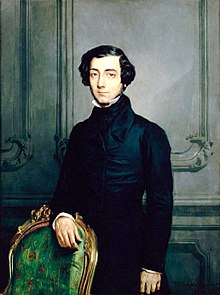
Alexis de Tocqueville

 While reading more Tocqueville's Democracy in America (see my first article on him here), I came across a chapter which particularly piqued my interest: "How American Democracy Has Modified the English Language". I found this article so insightful I felt I had to share it. Here are two extended quotes that I found particularly revealing:

The most common expedient employed by democratic nations to make an innovation in language consists in giving an unwonted meaning to an expression already in use. ... When a democratic people double the meaning of a word in this way, they sometimes render the meaning which it retains as ambiguous as that which it acquires. An author begins by a slight deflection of a known expression from its primitive meaning, and he adapts it, thus modified, as well as he can to his subject. A second writer twists the sense of the expression in another way; a third takes possession of it for another purpose.... The consequence is that writers hardly ever appear to dwell upon a single thought, but they always seem to aim at a group of ideas, leaving the reader to judge which of them he has hit.

This is a deplorable consequence of democracy. I had rather that the language should be made hideous with words imported from the Chinese, the Tartars, or the Hurons than that the meaning of a word in our own language should become indeterminate. ...Without clear phraseology there is no good language.

Just as a side note, I'm sure Chinese and Huron are beautiful languages in their own right and I have nothing against them--but Tocqueville's point is clear. Words are not mere marks on paper; they represent ideas; and when one artificially twists or obscures the meaning of a word, the idea becomes twisted or obscure as well. Words are not things to be taken lightly.

Saturday, June 1, 2013

Tocqueville: Prophet of Political Correctness?


Alexis de Tocqueville
"In America the majority raises formidable barriers around the liberty of opinion; within these barriers an author may write as he pleases, but woe to him if he goes beyond them."

The above quote sounds like a description of our modern "political correctness", doesn't it? We can easily see these words applied to dozens of situations concerning our current government and media. But this sentence was not written within the past few years, nor even within the past few decades. It was written by a Frenchman named Alexis de Tocqueville, who visited America in 1831.

Tocqueville was a man of remarkable insight. Born into post-Revolution France to aristocratic parents, he was keenly aware of his country's struggle towards democracy, and saw both the good and the evil that it could bring. He was especially fascinated by America, it being, in his eyes, the most completely democratic country in the world. In 1831 he travelled to America to study the government and the people there, and eventually wrote a book based on his observations and reflections, called Democracy in America.

By his writing it is easy to tell that Tocqueville is a supporter of democracy, but he is by no means a blind supporter. He knows that a democracy can be as tyrannical as a monarchy if it is immoral:

Fetters and headsmen were the coarse instruments that tyranny formerly employed; but the civilization of our age has perfected depotism itself, though it seemed to have nothing to learn. Monarchs had, so to speak, materialized oppression; the democratic republics of the present day have rendered it as entirely an affair of the mind as the will which it is intended to coerce. Under the absolute sway of one man the body was attacked in order to subdue the soul; but the soul escaped the blows which were directed against it and rose proudly superior. Such is not the course adopted by tyranny in democratic republics; there the body is left free, and the soul is enslaved. The master no longer says: "You shall think as I do or you shall die;" but he says: "You are free to think differently from me and to retain your life, your property, and all that you possess; but you are henceforth a stranger among your people. You may retain you civil rights, but they will be useless to you, for you will never be chosen by your fellow citizens if you solicit their votes; and they will affect to scorn you if you ask for their esteem. You will remain among men, but you will be deprived of the rights of mankind. Your fellow creatures will shun you like an impure being; and even those who believe in your innocence will abandon you, lest they should be shunned in their turn. Go in peace! I have given you your life, but it is an existence worse than death." (Democracy in America, "Unlimited Power of the Majority in the United States, and Its Consequences")

Tocqueville later admitted in the same article that this tendency of democratic tyranny was only "slightly perceptible" in America as yet, but that it was already a bad influence. Nineteenth-century Americans scoffed at Tocqueville's warning, but now it's a warning that is coming true. Anyone, especially, who is a supporter of traditional morality or the Catholic Church, is now subject in this country to vicious attack by the media.

Tocqueville knew that any form of government, democracy or monarchy, cannot long survive if it is not moral. Liberty is America's claim to fame; but when America begins attacking morality, it is only destroying its most precious possession. For true liberty can never exist without morality.