Saturday, May 10, 2014

Stevenson's Impossible Dream: "If This Were Faith"


Is there anyone who hasn't shivered with joy listening to the great song "Impossible Dream" from Man of La Mancha? (If you haven't heard it, go find a recording of it right now--you need to shiver with joy.) I cannot hear it without being lifted up and rejuvenated to my own quest for truth as a writer and a Catholic. Don Quixote may have been mad, but he was righter in his spiritual world than most of the rest of us. There's only one way to dream the impossible dream, fight the unbeatable foe, bear with unbearable sorrow, and reach the unreachable star--by submitting ourselves to God's grace and love in our daily lives (in this I am still a very novice page!). 
 
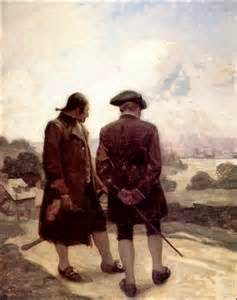
However, in this post I'd like to direct your attention to a non-fictional but no less unlikely Don Quixote, a skinny Scot with a penchant for words--Robert Louis Stevenson. RLS was a fine writer and poet, but he also loved people, and had a strong sense of right and wrong. A description of him written by his wife, Fanny, shows this better than any words of mine:
 
...[T]he path for himself showed plainly enough before him, and it was his duty to swerve neither to the right nor the left. He believed he had no rights, only underserved indulgences. He must not eat unearned bread, but must pay the world, in some fashion, for what it gave him,--first, materially, then in kindness, sympathy, and love. Class distinctions, so strictly observed in England, he could not tolerate and never gave the slightest heed to their limitations. "Ladies?" he said in reply to an observation by a visitor, "one of the truest ladies in Bournemouth, Mrs. Waats, is at this moment washing my study windows." Once, coming upon a crowd of young roughs who were tormenting a wretched drunken creature of the streets, he pushed his way through them, and amid their jeers offered his arm to the woman and escorted her to the place she called home. "Don Quixote," he once said to my son, with a startled look, "why, I am Don Quixote!" Too much ease frightened him; he would occasionally insist on some sharp discomfort, such as sleeping on a mat on the floor, or dining on a ship's biscuit, to awaken him, as he said, to realities; and nothing pleased him more than to risk his life or health to serve another. [...] Meanness or falsity or cruelty set his eyes blazing, and his language on such occasions became far from parliamentary.
 
So we even see that Stevenson explicitly identified with Cervantes' mad knight.
 
Recently while reading through RLS's poetry collection Songs of Travel (during breaks at driver's ed class, to keep my imagination from going totally dead), I encountered what seems like Stevenson's own "Impossible Dream". Written over a hundred years before the acclaimed song, "If This Were Faith" expresses the same sentiments in very stirring verse:
 
If This Were Faith
 
God, if this were enough,
That I see things bare to the buff
And up to the buttocks in mire;
That I ask nor hope nor hire,
Not in the husk,
Nor dawn beyond the dusk,
Nor life beyond death:
God, if this were faith?
 
Having felt Thy wind in my face
Spit sorrow and disgrace,
Having seen Thine evil doom
In Golgotha and Khartoum,
And the brutes, the work of Thy hands,
Fill with injustice lands
And stain with blood the sea:
If still in my veins the glee
Of the black night and the sun
And the lost battle, run:
If, an adept,
The iniquitous lists* I still accept
With joy, and joy to endure and be withstood,
And still to battle and perish for a dream of good:
God, if that were enough?
*lists=  jousting arena
 
If to feel, in the ink of the slough,
And the sink of the mire,
Veins of glory and fire
Run through and transpierce and transpire,
And a secret purpose of glory in every part,
And the answering glory of battle fill my heart;
To thrill with the joy of girded men
To go on for ever and fail and go on again,
To be mauled to the earth and arise,
And contend for the shade of a word and a thing not seen with the eyes:
With the half of a broken hope for a pillow at night
That somehow the right is the right
And the smooth shall bloom from the rough:
Lord, if that were enough?
 
The rhythm of this poem is the most jagged I have ever seen from Stevenson; I feel he must have written it in one of his high passions against meanness or falsity or cruelty. But read the last stanza again. It is so rich I cannot take it all apart. It's not just the ode of the knight. It's the cry of the artist, seeing beauty transpierce--(what a word!)--transpierce and transpire our fallen world. It's the song of the sinner, being mauled to earth by passions only to rise again. It's the joy of the saint--to contend for that lovely Thing not seen with eyes, but with the soul.
 
Let us all take hope in God's "impossible" dream for us that is the most real thing in the world.


Friday, May 2, 2014

Honest Alan: A Tribute


A note: Of late I have been posting on the sublime, the good, the true, the beautiful. This post is on the merely fun. Please forgive my outburst of Scottish geekiness!

Another note: My apologies, I got the date mixed up! June 2, not May 2, was my Scottish epiphany. Well, here is Alan anyway, a month early.
~
Looking at the date today, I realized it was rather significant--for me at least. Two years ago today began my obsession with all things Scottish. The blame lies with a writer named Robert Louis Stevenson, who brought to life one of my favorite fictional characters on the face of the earth. Introducing Alan Breck Stewart: clansman of Appin, Jacobite rebel, swordsman, piper, Gaelic poet, with an elephant-sized ego and a heart of gold. You'll be seeing several versions of him in this post, but the one I always carry in my mind is Stevenson's first description of him in Kidnapped:

He was smallish in stature, but well set and as nimble as a goat; his face was of a good open expression, but sunburnt very dark, and heavily freckled and pitted with the small-pox; his eyes were unusually light and had a kind of dancing madness in them, that was both engaging and alarming...

Please enjoy my own tribute in verse to my favorite swashbuckling Highland rebel. And then go read Kidnapped.
The Ballad of Alan Breck
O, have ye heard o' Alan Breck?
O, cam ye by nae word?
He's a dancin' madness in his e'e*,
An' a hand on the hilt o' his sword!
*eye
Young Alan trod the hills and crags,
His foot kenned* every stone,
For Appin and the Breadalbane
Were his heart-land an' his home.
*knew
Down by lang Loch Leven's shores
With the wind in the birches cryin',
He'd whistle mony a merry tune,
As would leave the birds all sighin'.
Now Alan was a swordsman's son,
He learned the fencer's trade,
An' often joy and pride he took
In the singin' o' the blade.
 
 But then man Alan's father died,
An' left him gey* an' poor,
So Alan went for sodger's* pay,
In the army o' King George.
*very   *soldier's
Ay, Alan once a red coat wore,
Because he had nae money,
But now he's changed it for a blue,
An' one that's much mair bonny!
He cannae stay in Scotland now,
For the savin' o' his neck,
For there's a hundred gleamin' pounds
On the head of Alan Breck.
Go on, ye redcoats, search the hills,
An' guard the Glencoe heights,
But all ye'll catch is a fleetin' glisk*
O' the canny Jacobite.
*glimpse
 
An' 'ware, ye seamen, when the fogs
Come swirlin' round the deck;
A mettled voice, a flashin' e'e--
It may be Alan Breck.
He's a Hielandman forever,
An' a Stewart tae the end;
Tho' a feisty, fechtin'* warrior,
He's a true an' doughty friend!
*fighting
O, have ye heard o' Alan Breck?
O, cam ye by nae word?
Ye'll ken him by his dancin' e'e,
An' the hand on the hilt o' his sword!
 
~Poem Ó
Mary Jessica Woods, 2013


Monday, April 28, 2014

Abyss of Light: St. John Paul II's "Letter to Artists"


I know, I know. This weekend the Catholic media is already overflowing with articles on the two newest saints of the Church, Popes John XXIII and John Paul II. Why more words? But let me first say that I feel extremely blessed to have lived while John Paul was still pope, although I was too young to appreciate it much. I'm appreciating it now, and that's the reason for this post. This past week I discovered (Saint!) John Paul II's "Letter to Artists", presented from the Vatican on Easter Sunday, 1999. (I was one and three-quarters at the time...)

In this beautiful and heartening letter, John Paul reminds artists of their divine calling, shows the intimate and mutually enriching relationship between art and the Church, and urges the artists of all kinds--writers, visual artists, architects and musicians--to renew that relationship and persevere in the pursuit of beauty. Indeed, he affirms, powerfully quoting Dostoyevsky, "beauty will save the world."

I loved the entire letter, but especially connected to the parts where John Paul speaks of artistic inspiration as an encounter with the divine. Granted I have only experienced this in fleeting moments--usually when writing a contemplative poem, or imagining a powerful character moment in my novel--but I feel I know exactly what he is talking about:

Every genuine artistic intuition goes beyond what the senses perceive and, reaching beneath reality's surface, strives to interpret its hidden mystery. The intuition itself springs from the depths of the human soul, where the desire to give meaning to one's own life is joined by the fleeting vision of beauty and of the mysterious unity of things. All artists experience the unbridgeable gap which lies between the work of their hands, however successful it may be, and the dazzling perfection of the beauty glimpsed in the ardour of the creative moment: what they manage to express in their painting, their sculpting, their creating is no more than a glimmer of the splendour which flared for a moment before the eyes of their spirit.

(Oh, that unbridgeable gap! Exquisite torture.) And again, writing of the Holy Spirit as the literal "in-spiration" or "in-breathing" of artists:

Dear artists, you well know that there are many impulses which, either from within or from without, can inspire your talent. Every genuine inspiration, however, contains some tremor of that “breath” with which the Creator Spirit suffused the work of creation from the very beginning. Overseeing the mysterious laws governing the universe, the divine breath of the Creator Spirit reaches out to human genius and stirs its creative power. He touches it with a kind of inner illumination which brings together the sense of the good and the beautiful, and he awakens energies of mind and heart which enable it to conceive an idea and give it form in a work of art. It is right then to speak, even if only analogically, of “moments of grace”, because the human being is able to experience in some way the Absolute who is utterly beyond.

Clearly John Paul's own artistic experience as a poet, actor, and playwright was very deep and powerful. I am only minimally familiar with his literary work, but I am very eager now to explore it and rediscover this great man and modern saint!

Sts. John XXIII and John Paul II, pray for us!

Sunday, April 20, 2014

Happy Pascha!

Christ is Risen! Indeed He is Risen!


A Pascha Psalm
 
By Mary Jessica Woods
 
Hear the faint heralds, O soldiers,
Calling distant above the far battleground.
Long have you fought in night's deepest hour,
Long have you struggled, sore-weary, with shadowy foes,
But now the sky pales, and the trumpets blare our afar,
"The Lord is at hand! The Lord and day of the victory!"
 
So rise up, ye soldiers! Prepare for the brilliant dawn,
That splendid and terrible morning of glory,
Rise up, and take up your shields,
Your shining helms and keen blades,
For the hour of vict'ry is upon you.
Rise and rejoice in the Lord!
 
Alas for those who stay slumbering,
Asleep in their tents, too weary,
Dead to the dawn of glory; it will pass them by,
Those who cannot stay alert, who cannot remain faithful,
It will pass over them like a sudden dream,
Fleeting and quickly forgotten.
 
But those who remain on the watch,
Straining their sight for the first-light of dawn,
Ready to join their Lord at a moment's command,
These are the soldiers of glory,
The steadfast and well-hailed fighters,
Who will scatter the darkness beside their all-conquering King.
 
So rise up, ye warriors of Christ!
 
  Ó 2012 Mary Jessica Woods


Saturday, April 19, 2014

Sorrowful Wonder and Joyful Impatience: Jerusalem Matins


One of my favorite services of the Church year in the Byzantine tradition is Holy Saturday morning, Jerusalem Matins. It's two hours long and is full of haunting melodies and beautiful texts that are never sung any other time. The highlight of the service is the three Stations, a series of short hymns sung in between verses of Psalm 118. The first theme, in these lines from the First Station, is the sheer strangeness of God in a grave:

In a grave they laid you, O my Life and my Christ,
yet the Lord of Death has been destroyed by your death,
and from you, the world now drinks rich streams of life.

Lo! how fair his beauty! Never was man so fair!
but how strangely death has changed that face that we knew
though all nature owes her beauty to him.

O my sweet Lord Jesus, my Salvation, my Light,
how are you by a grave and by its darkness hid?
How unspeakable the mystery of your love!

That last line--how unspeakable is His love--has been a major theme in my own reflections this Holy Week. The familiarity of the salvation story, I think, allows many of us, myself included, to take the whole thing for granted far too often. Why does God love us? I will not attempt to answer the question myself; but the simple fact of God's love still stands, like the "rich streams of life", incredible and alive and waiting to be drunk.

The second theme of the stations is the grief of the Virgin Mother:

When the Ewe that bore him saw them slaying her Lamb,
tossed by swelling waves of pain she sobbed for her woe,
and moved all the flock to join her bitter cries:

"Who will give me water for the tears I must weep,"
so the Maiden wed to God cried out in loud lament,
"that for my sweet Jesus I might rightly mourn?"

And from the Third Station:

"O my precious Springtime!
O my Son beloved,
O whither fades your beauty?"

This is some of the most emotional hymnity in the Byzantine Ruthenian tradition, at least in my experience. That last verse I especially love--"O my precious Springtime!" Spring has gone into the grave; winter has come instead of summer.

But by the middle of the Third Station we are already talking about the Resurrection again:

Rise, O Lord of mercy,
raising us up also
who languish deep in Hades.

"Rise, O life-bestower!"
said the one who bore you,
your grief-torn weeping Mother.

Hasten with your rising
and release from sorrow
the spotless Maid who bore you.

With typical Byzantine enthusiasm, we actually beg Christ to hurry up and rise from the dead so we can start celebrating!

Jerusalem Matins is a unique and gorgeous service and a wonderful meditation for the end of Holy Week. I hope everyone has a beautiful Holy Saturday and a glorious Pascha!

 
Christ is Risen (almost)!


Thursday, April 10, 2014

The Stalwart Soul: Frost's "A Lone Striker"


Meet my newest favorite American poet: Robert Frost.

Most of us are familiar with a few of his more famous poems, namely "The Road Less Taken" and "Stopping by Woods on a Snowy Evening." These two are truly small masterpieces, but, as I've discovered, he had so many more! Several months ago for Great Books I read his "New Hampshire" collection and I was delighted by his realism, wit, and what I can only describe as a certain soberness of style. Frost is not your anguished, broken-world modernist. He has ground under his feet.

Over Christmas I was happy to discover a volume of Frost's collected writings tucked away in the corner of a bookshelf at my grandparents' house. While working through his complete poems, I have marked many favorites. One of these is "A Lone Striker".

The poem opens with a factory hand arriving late to work to find himself locked out for half an hour, as punishment. In this unexpected free time the worker contemplates the marvel of the man-made machine, and yet questions its ultimate value:

Man's ingenuity was good.
He saw it plainly where he stood,
Yet found it easy to resist.

In the end the man decides to go on lone strike for a day and take a walk in the woods:

If--if he stood! Enough of ifs!
He knew a path that wanted walking;
He knew a spring that wanted drinking;
A thought that wanted further thinking;
A love that wanted re-renewing.
Nor was this just a way of talking
To save him the expense of doing.
With him it boded action, deed.

Go ahead--read it aloud. I love the rigor of rhythm and arch of line here. In fact these lines struck me so deeply that they stayed in my mind without my even trying to memorize them. But why?  Because they spoke to my love of truth, beauty, and goodness.

Throughout the poem Frost emphasizes the un-humanness of the factory. Its only purpose is the mass-production of a thing. The human workers are only there to fix the machines when they break. In the context of the factory, the people, too, are merely parts of the machine, with its single material purpose.

But the lone striker would have more. He desires cliffs, trees, water; space to breath and think and love--truly human occupations. He does not totally condemn industry--as he implies by the line "Man's ingenuity was good"--but he asks for something deeper, more fulfilling. He would have a soul free to pursue beauty.

This is exactly how I feel about my pursuit of a Great Books education. The norm in colleges today is to prepare its students for a specialized occupation in society. Of course this is not a wholly bad thing. We need doctors and engineers and scientists. But civilization needs more that that. It needs humans. And we will never find our humanity if we limit it to merely a material livelihood. That's why we need wonderful poets like Robert Frost.

"A Lone Striker" is another clarion call to me on my journey to a true liberal arts education. I too know a path that wants walking, a spring that wants drinking, a love that wants renewing. The adventure has hardly begun.


Monday, April 7, 2014

Long Time No Write

An understatement, to say the least. It's been nearly a year since I started this blog, and I'm finally coming back! In brief, my novel-writing took me to the end of summer and the beginning of a very busy senior year of high school. Now things are beginning to wind down (well, not yet--but soon) and I have my gap year stretched ahead of me in all its glory. So, look out for more posts on literature and faith in the near future. First up, I believe, will be a bit on my newest favorite American poet, Robert Frost.

I say. It's rather good to be back.