This week was the beginning of my summer break. One of the things I promised myself I would do this summer is finish a draft of the Civil War/time travel novel I'm working on. So this week I started devoting at least a couple hours a day to writing. The novel is going very well, but I've decided that I can't finish a novel and keep up/promote a blog at the same time. Basically, I'm taking the summer off blogging. When I finish a draft of the book and can put it away for a while, then I can turn the attention to this blog that it deserves.
I don't think I'm disappointing too many people at this point, but I know that I'm disappointed I'll have to wait to write those Stevenson posts. : (
Oh, well. In the meantime, if you're here, feel free to read past articles. I'll also still have time to reply to comments, so please leave some! : )
Tìoraidh an-drasta!
("Cheerio for now" in Gaelic!)
Mary
Friday, June 14, 2013
Saturday, June 8, 2013
"Sea Fever" by John Masefield

For my post this week I'd simply like to share a favorite work of mine by the English poet John Masefield. "Sea Fever" is probably the most well-known of Masefield's poems. I know that Masefield wrote a considerable amount of poetry, along with some novels, that I have not got around to reading yet. Judging from the quality of this poem, I have a lot to look forward to. The first time I read "Sea Fever" it took my breath away, and in subsequent readings it has brought tears to my eyes with its sheer beauty.
Sea Fever
by John Masefield
I must go down to the seas again, to the lonely sea and the sky,
And all I ask is a tall ship and a star to steer her by;
And the wheel's kick and the wind's song and the white sail's shaking,
And a gray mist on the sea's face, and a gray dawn breaking.
I must go down to the seas again, for the call of the running tide
Is a wild call and a clear call that may not be denied;
And all I ask is a windy day with the white clouds flying,
And the flung spray and the blown spume, and the sea-gulls crying.
I must go down to the seas again, to the vagrant gipsy life,
To the gull's way and the whale's way where the wind's like a whetted knife;
And all I ask is a merry yarn from a laughing fellow-rover,
And quiet sleep and a sweet dream when the long trick's over.
Wednesday, June 5, 2013
Tocqueville on Language
 |
| Alexis de Tocqueville |
While reading more Tocqueville's Democracy in America (see my first article on him here), I came across a chapter which particularly piqued my interest: "How American Democracy Has Modified the English Language". I found this article so insightful I felt I had to share it. Here are two extended quotes that I found particularly revealing:
The most common expedient employed by democratic nations to make an innovation in language consists in giving an unwonted meaning to an expression already in use. ... When a democratic people double the meaning of a word in this way, they sometimes render the meaning which it retains as ambiguous as that which it acquires. An author begins by a slight deflection of a known expression from its primitive meaning, and he adapts it, thus modified, as well as he can to his subject. A second writer twists the sense of the expression in another way; a third takes possession of it for another purpose.... The consequence is that writers hardly ever appear to dwell upon a single thought, but they always seem to aim at a group of ideas, leaving the reader to judge which of them he has hit.
This is a deplorable consequence of democracy. I had rather that the language should be made hideous with words imported from the Chinese, the Tartars, or the Hurons than that the meaning of a word in our own language should become indeterminate. ...Without clear phraseology there is no good language.
Just as a side note, I'm sure Chinese and Huron are beautiful languages in their own right and I have nothing against them--but Tocqueville's point is clear. Words are not mere marks on paper; they represent ideas; and when one artificially twists or obscures the meaning of a word, the idea becomes twisted or obscure as well. Words are not things to be taken lightly.
Saturday, June 1, 2013
Tocqueville: Prophet of Political Correctness?
"In America the majority raises formidable barriers around the liberty of opinion; within these barriers an author may write as he pleases, but woe to him if he goes beyond them."
The above quote sounds like a description of our modern "political correctness", doesn't it? We can easily see these words applied to dozens of situations concerning our current government and media. But this sentence was not written within the past few years, nor even within the past few decades. It was written by a Frenchman named Alexis de Tocqueville, who visited America in 1831.
Tocqueville was a man of remarkable insight. Born into post-Revolution France to aristocratic parents, he was keenly aware of his country's struggle towards democracy, and saw both the good and the evil that it could bring. He was especially fascinated by America, it being, in his eyes, the most completely democratic country in the world. In 1831 he travelled to America to study the government and the people there, and eventually wrote a book based on his observations and reflections, called Democracy in America.
By his writing it is easy to tell that Tocqueville is a supporter of democracy, but he is by no means a blind supporter. He knows that a democracy can be as tyrannical as a monarchy if it is immoral:
Fetters and headsmen were the coarse instruments that tyranny formerly employed; but the civilization of our age has perfected depotism itself, though it seemed to have nothing to learn. Monarchs had, so to speak, materialized oppression; the democratic republics of the present day have rendered it as entirely an affair of the mind as the will which it is intended to coerce. Under the absolute sway of one man the body was attacked in order to subdue the soul; but the soul escaped the blows which were directed against it and rose proudly superior. Such is not the course adopted by tyranny in democratic republics; there the body is left free, and the soul is enslaved. The master no longer says: "You shall think as I do or you shall die;" but he says: "You are free to think differently from me and to retain your life, your property, and all that you possess; but you are henceforth a stranger among your people. You may retain you civil rights, but they will be useless to you, for you will never be chosen by your fellow citizens if you solicit their votes; and they will affect to scorn you if you ask for their esteem. You will remain among men, but you will be deprived of the rights of mankind. Your fellow creatures will shun you like an impure being; and even those who believe in your innocence will abandon you, lest they should be shunned in their turn. Go in peace! I have given you your life, but it is an existence worse than death." (Democracy in America, "Unlimited Power of the Majority in the United States, and Its Consequences")
Tocqueville later admitted in the same article that this tendency of democratic tyranny was only "slightly perceptible" in America as yet, but that it was already a bad influence. Nineteenth-century Americans scoffed at Tocqueville's warning, but now it's a warning that is coming true. Anyone, especially, who is a supporter of traditional morality or the Catholic Church, is now subject in this country to vicious attack by the media.
Tocqueville knew that any form of government, democracy or monarchy, cannot long survive if it is not moral. Liberty is America's claim to fame; but when America begins attacking morality, it is only destroying its most precious possession. For true liberty can never exist without morality.
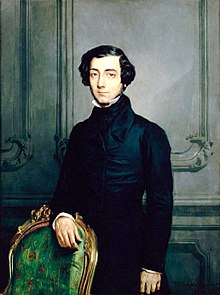 |
| Alexis de Tocqueville |
The above quote sounds like a description of our modern "political correctness", doesn't it? We can easily see these words applied to dozens of situations concerning our current government and media. But this sentence was not written within the past few years, nor even within the past few decades. It was written by a Frenchman named Alexis de Tocqueville, who visited America in 1831.
Tocqueville was a man of remarkable insight. Born into post-Revolution France to aristocratic parents, he was keenly aware of his country's struggle towards democracy, and saw both the good and the evil that it could bring. He was especially fascinated by America, it being, in his eyes, the most completely democratic country in the world. In 1831 he travelled to America to study the government and the people there, and eventually wrote a book based on his observations and reflections, called Democracy in America.
By his writing it is easy to tell that Tocqueville is a supporter of democracy, but he is by no means a blind supporter. He knows that a democracy can be as tyrannical as a monarchy if it is immoral:
Fetters and headsmen were the coarse instruments that tyranny formerly employed; but the civilization of our age has perfected depotism itself, though it seemed to have nothing to learn. Monarchs had, so to speak, materialized oppression; the democratic republics of the present day have rendered it as entirely an affair of the mind as the will which it is intended to coerce. Under the absolute sway of one man the body was attacked in order to subdue the soul; but the soul escaped the blows which were directed against it and rose proudly superior. Such is not the course adopted by tyranny in democratic republics; there the body is left free, and the soul is enslaved. The master no longer says: "You shall think as I do or you shall die;" but he says: "You are free to think differently from me and to retain your life, your property, and all that you possess; but you are henceforth a stranger among your people. You may retain you civil rights, but they will be useless to you, for you will never be chosen by your fellow citizens if you solicit their votes; and they will affect to scorn you if you ask for their esteem. You will remain among men, but you will be deprived of the rights of mankind. Your fellow creatures will shun you like an impure being; and even those who believe in your innocence will abandon you, lest they should be shunned in their turn. Go in peace! I have given you your life, but it is an existence worse than death." (Democracy in America, "Unlimited Power of the Majority in the United States, and Its Consequences")
Tocqueville later admitted in the same article that this tendency of democratic tyranny was only "slightly perceptible" in America as yet, but that it was already a bad influence. Nineteenth-century Americans scoffed at Tocqueville's warning, but now it's a warning that is coming true. Anyone, especially, who is a supporter of traditional morality or the Catholic Church, is now subject in this country to vicious attack by the media.
Tocqueville knew that any form of government, democracy or monarchy, cannot long survive if it is not moral. Liberty is America's claim to fame; but when America begins attacking morality, it is only destroying its most precious possession. For true liberty can never exist without morality.
Saturday, May 25, 2013
Project R.L.S. #2 ~ Discovering Stevenson

Whenever I explore Robert Louis Stevenson's work more deeply, I always feel a sense of gratitude. He is a constant joy to me and I can hardly imagine what my experience of literature would be like without him. Now that he's made such a big impact on me, I find it interesting to look back and trace how it all began.
My first exposure to Stevenson was, naturally enough, his Child's Garden of Verses. When we were little my dad would have me and my siblings memorize poetry, including several of the more famous selections from Child's Garden. I did not know anything about Stevenson at the time, of course, but already I began to associate his name with adventure, imagination, and wonder. One poem I remember in particular was "Pirate Story", in which three children roam the high seas of their backyard field. There was a certain line of description which left a permanent impression on me:
And waves are on the meadow like the waves there are at sea.The image had never occurred to me before, but every time afterwards that I saw long grass rippling in the wind, I thought of that poem, and of the sea.
The only other experience of Stevenson that I had at the time I enjoy looking back and laughing at. We used to have an abridged illustrated edition of Treasure Island, one of those with pictures on every other page. I used to take out the book and look at all the pictures but not read a single word of the story. Later we acquired a real edition of Treasure Island, which I tried to read a few times, but somehow never got past the first couple chapters--complaining that I couldn't understand it. (I'm still not sure how I managed that, but the truth remains: I didn't read Treasure Island straight through until last summer!)
As the years went on I became vaguely aware that Stevenson had written two other books called Kidnapped and Jekyll and Hyde, but I had no interest in either of them, especially since I had barely any idea of what they were about. I was also probably too busy reading Brian Jacques' Redwall series. But our parents insisted that we read classics occasionally, so I remember one day finding Kidnapped on my brother's bed where my mom had left it. I skimmed the summary on the back cover, and under the strange impression that the story took place in the Americas, I idly flipped it open and read part of a chapter. It didn't excite me. I was also still under the strange impression that classics were boring.
So I'm not exactly sure what happened between then and a certain fateful day in February 2011. It was a chilly Sunday morning and I was looking for something to do before we went to Liturgy. In my brother's room I spotted a large book on his dresser--a collection of famous Stevenson novels. I have no memory of what prompted me to do it, but I decided to read Kidnapped.
Sunday, May 19, 2013
Foils and Faith: Chesterton's "The Ball and the Cross"

Chesterton is one of my favorite authors, Catholic or otherwise, but it's taken me a long time to warm up to his novels. His apologetics, like the classic Orthodoxy, and short fictions, like the famous Father Brown detective stories, are pretty straightforward, at least for Chesterton. But anyone who has read Manalive or The Man Who Was Thursday knows that his novels can get absolutely out of this world.
So either I was finally ready for Chesterton craziness--or I was just in the mood--but I absolutely loved The Ball and the Cross. It's the first book I've read in a long time that has swept me away long into the night. Beginning with a flying ship, ending with a miracle, and filled up in between with chases, duels, romance, lunatic asylums, and theology, this is a book that I wanted to read over again almost as soon as I'd finished it. So let me start from the beginning.
The main plot revolves around two men who seem dire opposites--James Turnbull, a fiery Lowland Scotch atheist; and Evan MacIan, a young, mystic Catholic Highlander. But they are similar in that they're both so fiercely entrenched in their respective beliefs that they're willing to fight for them--literally. So when MacIan smashes the window of Turnbull's London newspaper shop--it contained an article blaspheming the Virgin Mary--both men readily agree to an old-fashioned duel to settle the matter. Unfortunately for the duellists, the London police don't see it quite so simply. Thus the mortal enemies find themselves allies in a haphazard escapade across the English countryside, forever trying to find a spot where they can just kill each other quietly and be done with it. But as the story moves on and their plans are foiled with Providential consistency, the two men begin to realize that they are not so opposed as they thought, and that there is a greater Enemy than the police whom they must unite to overthrow.
Sunday, May 12, 2013
Thoughts on "Jane Eyre": Let the Classics Speak!
In the library of the public high school I attend for choir class, there is a poster on the wall depicting Shakespeare sitting in front of a laptop. The caption on the poster reads, "What are they saying about me now?"
Whoa. Back up a second. "What are they saying about Shakespeare"? Whatever happened to what Shakespeare has to say? But it isn't about Shakespeare anymore. No, now it's "how many social and political aspirations we can throw on Shakespeare"--or on any other great writer, for that matter. I have noticed more and more that today's literary critics and scholars--in an ironically narrow-minded approach--tend to construe the classics into our own modern, secular, materialist mindset. Invariably, the result is an ugly and sterilized re-visioning of a really beautiful piece of literature.
I had a very interesting experience of this recently while reading Charlotte Bronte's Jane Eyre. I had never read the book before. The copy of Jane Eyre that I picked up from the library (the same library, incidentally, that had the misled Shakespeare poster) was a Penguin Classics edition, "enriched" with a new introduction and endnotes. The summary on the back cover summed up the book thus: "A novel of intense power and intrigue, Jane Eyre (1847) dazzled and shocked readers with its passionate depiction of a woman's search for equality and freedom."
"A woman's search for equality and freedom"? That put me on my guard. I flipped open to the introduction, and my fears were confirmed--Jane Eyre was being put forward as a triumph of political and social rebellion, which spoke out against authority and convention. It was almost hailed for being feminist. My heart fell at once. I had wanted to read a good story, not a subversive feminist manifesto.
But I couldn't be sure yet what it was. In Bronte's own preface to Jane Eyre, written for her contemporaries, she admits that the book might seem radical to some. But, she retorts, "Conventionality is not morality....narrow human doctrines, that only tend to elate and magnify a few, should not be substituted for the world-redeeming creed of Christ." Somehow, this just didn't sound feminist to me. It sounded Christian.
Whoa. Back up a second. "What are they saying about Shakespeare"? Whatever happened to what Shakespeare has to say? But it isn't about Shakespeare anymore. No, now it's "how many social and political aspirations we can throw on Shakespeare"--or on any other great writer, for that matter. I have noticed more and more that today's literary critics and scholars--in an ironically narrow-minded approach--tend to construe the classics into our own modern, secular, materialist mindset. Invariably, the result is an ugly and sterilized re-visioning of a really beautiful piece of literature.
I had a very interesting experience of this recently while reading Charlotte Bronte's Jane Eyre. I had never read the book before. The copy of Jane Eyre that I picked up from the library (the same library, incidentally, that had the misled Shakespeare poster) was a Penguin Classics edition, "enriched" with a new introduction and endnotes. The summary on the back cover summed up the book thus: "A novel of intense power and intrigue, Jane Eyre (1847) dazzled and shocked readers with its passionate depiction of a woman's search for equality and freedom."
"A woman's search for equality and freedom"? That put me on my guard. I flipped open to the introduction, and my fears were confirmed--Jane Eyre was being put forward as a triumph of political and social rebellion, which spoke out against authority and convention. It was almost hailed for being feminist. My heart fell at once. I had wanted to read a good story, not a subversive feminist manifesto.
But I couldn't be sure yet what it was. In Bronte's own preface to Jane Eyre, written for her contemporaries, she admits that the book might seem radical to some. But, she retorts, "Conventionality is not morality....narrow human doctrines, that only tend to elate and magnify a few, should not be substituted for the world-redeeming creed of Christ." Somehow, this just didn't sound feminist to me. It sounded Christian.
Subscribe to:
Posts (Atom)